



The IVOQA team at the Hospital Universitario Viamed Santa Elena has published a pioneering study focused on developing new strategies to expand access to advanced treatments for patients with peritoneal carcinomatosis.
The Challenge of the “Inaccessible Abdomen”: How to Expand Access to the PIPAC Technique?
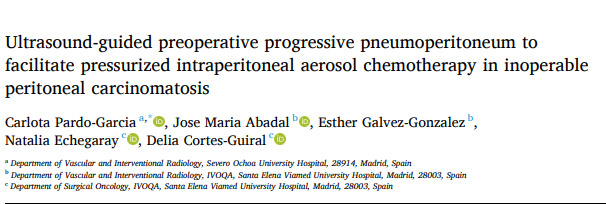
The study, titled “Ultrasound-guided Preoperative Progressive Pneumoperitoneum to Facilitate Pressurized Intraperitoneal Aerosol Chemotherapy in Inoperable Peritoneal Carcinomatosis,” addresses one of the main technical limitations of PIPAC (pressurized intraperitoneal aerosol chemotherapy): the so-called “inaccessible abdomen.” This condition affects approximately 5% of patients with peritoneal carcinomatosis due to extensive abdominal adhesions resulting from previous surgeries.
The prospective study evaluated the feasibility and safety of ultrasound- and hydrodissection-guided preoperative progressive pneumoperitoneum (PPP) in five patients with inoperable peritoneal carcinomatosis and previously inaccessible abdomens. Thanks to this technique, all inaccessible abdomens were successfully converted into accessible ones, allowing for the safe administration of PIPAC or ePIPAC in 100% of cases, with zero procedure-related complications.
Study Results and SERAM Recognition for Oncological Advancement
This publication represents a significant breakthrough in peritoneal oncology, as it offers a practical and reproducible solution for patients who, until now, were excluded from advanced intraperitoneal therapies due to the inability to achieve safe laparoscopic access.
Furthermore, this work was honored with the “Merit Award” by SERAM (Sociedad Española de Radiología Médica / Spanish Society of Medical Radiology) during its 38th Congress, highlighting the innovation and multidisciplinary approach of the project.
The research involved Dr. Delia Cortés Guiral, Jose Maria Abadal Villayandre, Dr. Natalia Echegaray Nuñez, Esther Gálvez, and Dr. Carlota Pardo García, reinforcing IVOQA’s commitment to clinical research and the development of new therapeutic strategies for advanced peritoneal carcinomatosis.


