

PIPAC (Pressurised Intra Peritoneal
Aerosolised Chemotherapy)
PIPAC stands for Pressurised Intra Peritoneal Aerosolised Chemotherapy, and it is a treatment we offer to patients whose cancer has spread to their abdomen who, until recently, could only be offered palliative treatment
What does the PIPAC procedure involve?
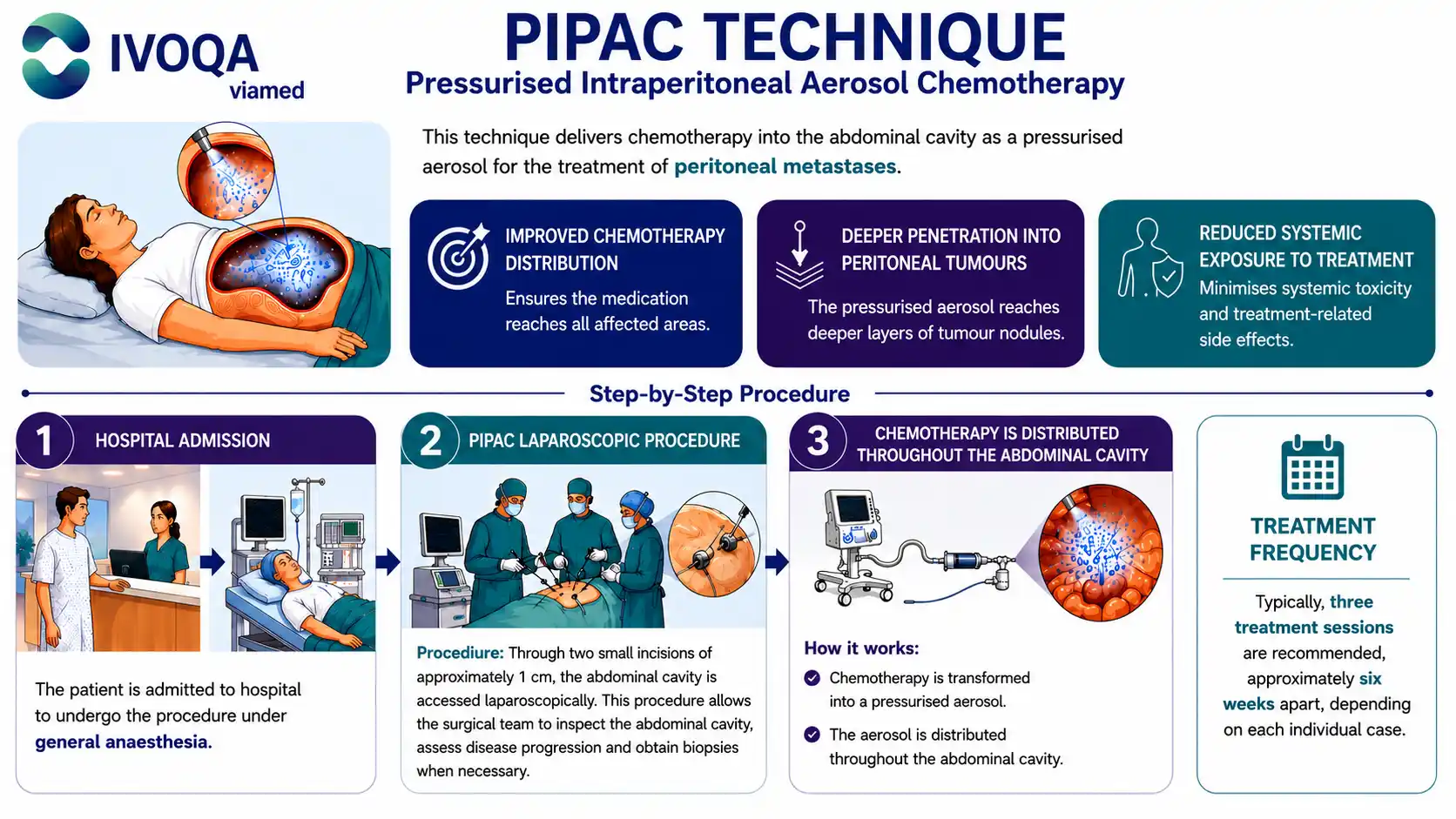
PIPAC is a minimally invasive procedure, which is why it is very well tolerated by patients.

Explore the entire abdomen

Record a video documenting the extent of the disease and how it responds to PIPAC treatment

Take biopsies and cytology for our specialist pathologists to analyse the effect of PIPAC treatment

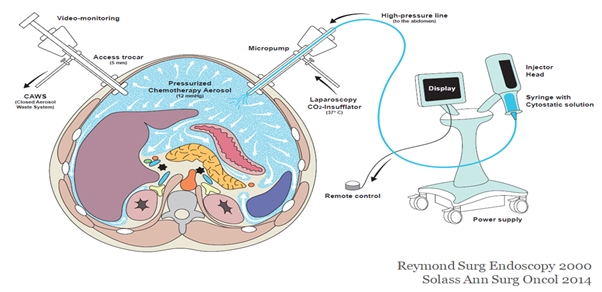
Apply chemotherapy in the form of a pressurised aerosol or spray, thanks to which we improve penetration in the tumour nodules, without the chemotherapy passing into the blood (or a small amount), which is why we manage to avoid the harmful side effects of intravenous chemotherapy

After 30 minutes, the procedure is completed, the incisions are closed, and the patient returns comfortably to their room

The total time taken is usually less than 90 minutes
It is a curative treatment for patients with advanced cancer that has spread to the peritoneum. This is known as peritoneal carcinomatosis or peritoneal metastases.
The primary tumour may be located:

Stomach, colon, small intestine, ovary, pancreas, endometrium, appendix (one of its variants is peritoneal pseudomyxoma), sarcoma, cholangiocarcinoma, kidney cancer.

Lung cancer, breast cancer, melanoma.

Peritoneal mesothelioma, primary peritoneal cancer.
PIPAC offers very promising results in slowing disease progression, reducing symptoms, and prolonging life.
Approximately 16% of patients treated with PIPAC have such a significant response that they may end up being treated with surgery and HIPEC.
The percentage of patients with very advanced disease in the peritoneum, who are not eligible for HIPEC due to advanced nature of the cancer and its resistance to chemotherapy in which we obtain a response is
Due to their experience and number of cases treated, both in Spain and abroad, the IVOQA team are leading professionals in the PIPAC procedure. Dr. Delia Cortés Güiral has been certified to perform PIPAC since 2016, is a member of the PIPAC international instructor team and has trained many surgeons from around the world through official PIPAC courses in different countries (Singapore, UAE, Switzerland, Saudi Arabia, France, Israel…) both face-to-face and online.
Both she and her team offer high-level care to patients worldwide with carcinomatosis or peritoneal metastases.
Dr. Cortés directs the first and only international course in the treatment of peritoneal disease using minimally invasive techniques: laparoscopic peritonectomy, laparoscopic HIPEC, PIPAC (organised within the official courses of the European Society of Surgical Oncology – ESSO).
Taxanes are one of the most useful families of anticancer drugs. To reduce toxicity and improve efficacy, new formulations of soluble nanoparticles have been developed. One such formulation is albumin-bound nanoparticles in water, stabilised with albumin and without a cremophore. This formulation has better solubility and less toxicity compared to previous versions.
In addition, this nanoparticle formulation can be administered at higher doses and concentrations. Due to its superior clinical efficacy and safety profile, it received FDA approval for metastatic breast cancer in 2008 and for non-small cell lung cancer in 2011.
Among gastrointestinal cancers, it is now approved in the US for the treatment of patients with metastatic pancreatic adenocarcinoma as first-line therapy in combination with another agent. In addition, several clinical trials have suggested the potential efficacy of this formulation as a single agent or in combination with other agents for the treatment of metastatic oesophageal, gastric, intestinal and biliary tract cancers.
This formulation has been shown to have higher overall response rates, with increased progression-free survival, overall survival and a superior safety profile with fewer adverse effects in patients with cancers of the gastrointestinal tract.
The use of these nanoparticles for PIPAC treatment for patients with peritoneal metastases or unresectable peritoneal carcinomatosis was described in the prestigious scientific journal The Lancet. In this rigorous work they found that PIPAC in this formulation was well tolerated and defined appropriate treatment doses according to patient conditions.
Pharmacokinetic analysis demonstrated a slow elimination of the drug from the peritoneal cavity and how the amount of drug accumulated in the tumour tissue after repeated treatments with PIPAC. Patients’ quality of life remained stable and a promising anticancer response was observed.
The PIPAC procedure is well tolerated. Thanks to the analgesia administered by our anaesthesiologists, you will not feel pain, only slight discomfort
You can return home the day after surgery.
Patients coming from abroad can return to their hotel the next day and have to wait a few days before they can travel by plane.
PIPAC will help you maintain your quality of life even if the tumour is very advanced, and in a large percentage of patients, PIPAC controls the formation of ascites (fluid build-up in the abdomen). Therefore, the abdominal swelling and discomfort resulting from ascites will improve or disappear in a large number of cases.
We currently recommend 3 PIPAC sessions, one every 6 weeks,
if possible having two cycles of systemic chemotherapy between each PIPAC.
There are also patients in special situations or who do not tolerate intravenous chemotherapy, in which case they are only treated with PIPAC with different frequencies.
All patients who benefit from this new procedure are registered in an international database for their safety and benefit from highly structured post-operative follow-ups.
The personal data collected will be processed in a strictly confidential manner and will be anonymised.
All interventions come with possible adverse effects.
In the case of PIPAC, they are