


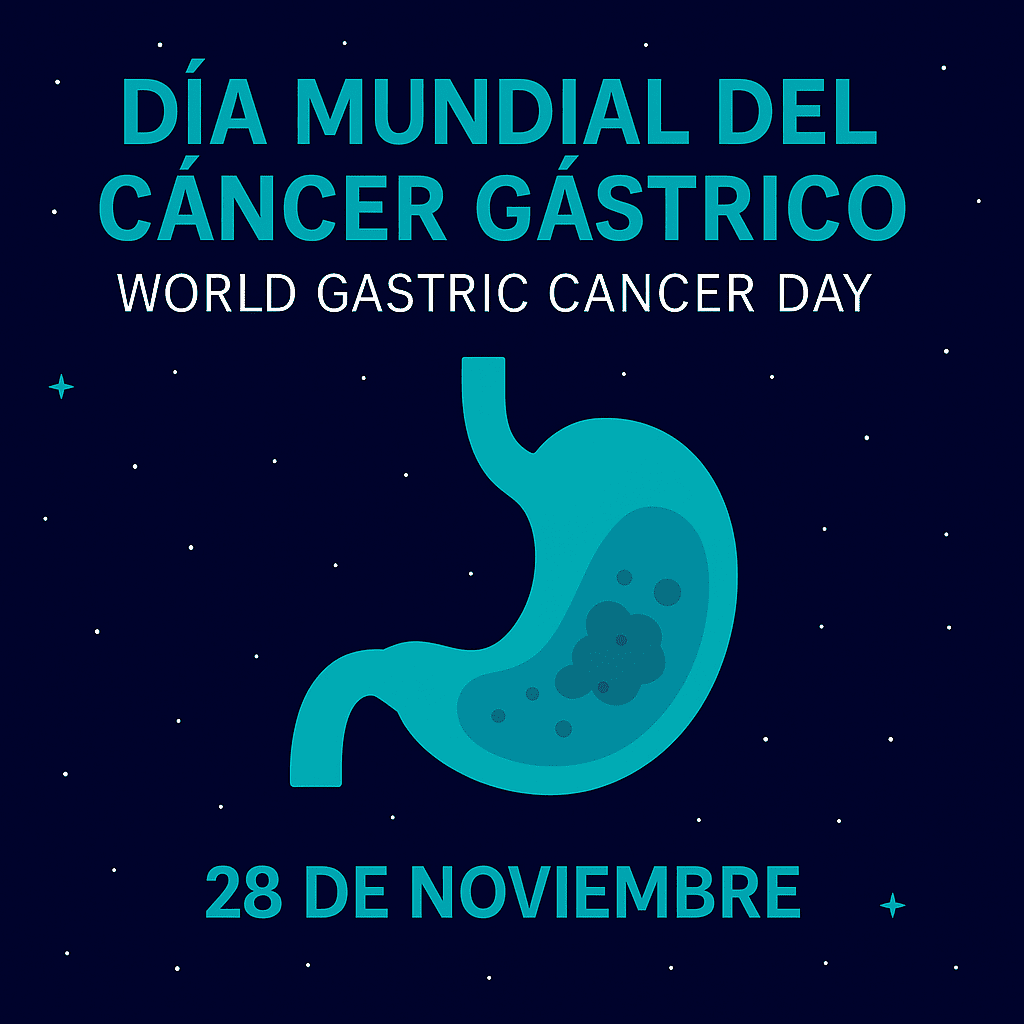
Each year, International Gastric Cancer Day serves as a reminder to raise awareness of a disease that, although less common than other tumors, represents a major public health challenge. The purpose of this observance is to mobilize society, healthcare professionals, and health policy decision-makers to strengthen prevention, early diagnosis, and effective treatment.
The impact of this tumor worldwide and in Spain
Worldwide, gastric cancer was the 5th most frequent type of cancer in 2020, with more than 1,089,000 new cases and around 768,793 deaths (AECC). In Spain, the tumor ranks 10th in incidence, with an estimated 7,303 new cases in 2023 (4,343 men and 2,960 women). It also represents one of the leading causes of cancer mortality in certain age groups.
The objective of the campaign: raising awareness, preventing, and diagnosing earlier
The campaign seeks to achieve three major goals:
- Raise awareness of this type of cancer among both the general population and medical professionals.
- Prevent through the identification and reduction of modifiable risk factors.
- Diagnose earlier through education on warning symptoms and reinforcement of fast-track care pathways, which can improve survival.
Gastric cancer: what it is and how it develops
Role of the stomach and how cancer originates
The stomach is an organ of the digestive system that mixes food with gastric juices, initiates chemical digestion, and moves the content toward the intestine. Gastric cancer primarily develops when the cells of the gastric mucosa (the innermost layer) begin to multiply uncontrollably, infiltrating the stomach wall and potentially spreading through lymphatic or blood pathways.
Main types of gastric cancer (adenocarcinoma, lymphoma, GIST)
The most frequent types are:
- Gastric adenocarcinoma, which originates from the glands of the gastric mucosa.
- Gastric lymphoma, involving the lymphatic tissue of the stomach.
- GIST (gastrointestinal stromal tumor), which is less common but can also occur in the stomach and requires a specific diagnostic/treatment approach.
Factors that influence progression and prognosis
The prognosis depends on multiple variables: tumor location, extent, lymph node involvement, patient’s overall condition, and the presence of biomarkers. The speed of diagnosis and chosen treatment also influence prognosis.
Gastric cancer data in Spain
Incidence and mortality according to REDECAN and SEOM
In Spain, the incidence of gastric cancer is estimated at around 7,303 new cases for 2023. Overall data indicate that this tumor represents a significant health issue and generates a high medical and economic burden. A recent study estimates that between 2013 and 2022, there were 51,814 premature deaths due to gastric cancer in Spain.
Differences by sex and age
The tumor is approximately twice as common in men as in women. Additionally, risk increases significantly from ages 50–60 and is more prevalent in older individuals.
5-year survival rate and current trends
Five-year survival varies widely depending on the stage at diagnosis. Recent data show that in a large proportion of cases diagnosed at advanced stages, survival is still limited. Although incidence has decreased in some subtypes thanks to improved infection control and lifestyle changes, the challenge remains significant.
Peritoneal metastasis
Up to 15% of patients with gastric cancer present peritoneal metastases at diagnosis, and up to 32–43% develop peritoneal metastases during follow-up after initial surgery. Therefore, proper monitoring and treatment in specialized reference centers for peritoneal disease is essential for patients with gastric cancer and peritoneal metastasis.
Risk factors: genetics, infections, and lifestyle
Helicobacter pylori infection and its role in cancer development
Chronic H. pylori infection is a recognized risk factor for the development of gastric cancer, especially adenocarcinoma. Timely eradication can reduce risk.
Diets high in salt and processed foods
A diet high in salt, processed and preserved foods, and low in fruits and vegetables has been associated with increased risk.
Tobacco, alcohol, and obesity
Smoking, excessive alcohol consumption, and overweight/obesity also increase the probability of developing this tumor.
Family history and hereditary genetic mutations (CDH1, Lynch)
Certain hereditary syndromes and genetic mutations (e.g., CDH1 gene mutation or Lynch syndrome) can significantly increase gastric cancer risk.
Primary prevention measures: healthy diet, weight control, and smoking cessation
The best prevention includes healthy lifestyle habits: a diet rich in fruits and vegetables, low in salt and processed foods, regular physical activity, avoiding smoking and excessive alcohol, and maintaining a healthy body weight.
Early detection: key to improving survival
Initial symptoms and warning signs (dyspepsia, weight loss, anemia, persistent nausea)
It is important to pay attention to persistent symptoms that may go unnoticed, such as recurrent dyspepsia, early fullness, unexplained weight loss, anemia of unknown origin, persistent nausea, or vomiting.
When to see a specialist
If these symptoms persist—especially in people with risk factors—it is advisable to consult a gastroenterologist or general surgeon for evaluation and early diagnostic testing.
Diagnostic tools: endoscopy, biopsy, tumor markers, and imaging
Diagnosis is based on upper GI endoscopy with biopsy, imaging tests (CT, MRI) for staging, and in some cases tumor markers. Early detection improves the chances of curative treatment.
Staging laparoscopy may also be indicated, especially in T3 and T4 tumors, to determine whether peritoneal carcinomatosis is present.
Surveillance programs for at-risk groups (family history or persistent H. pylori infection)
In patients with a family history of gastric cancer or chronic H. pylori infection, specialized follow-up programs are recommended to detect premalignant lesions or early-stage cancer.
Recent advances in the treatment of gastric cancer
Advanced oncologic surgery and minimally invasive techniques
Surgery remains a key curative treatment when the tumor is resectable. In recent years, minimally invasive techniques (laparoscopy, robotic surgery) and advanced reconstruction strategies have reduced recovery time and complications.
New perioperative and adjuvant chemotherapy regimens
Chemotherapy regimens administered before and after surgery have been refined to improve outcomes. Combined and intensified protocols have shown better effectiveness in some patient subgroups.
Targeted therapies based on biomarkers (HER2, MSI, PD-L1)
Biomarkers such as HER2, microsatellite instability (MSI), or PD-L1 expression allow personalized treatment by incorporating targeted therapies or immunotherapy when indicated.
Immunotherapy and personalized treatments
Immunotherapy is being increasingly integrated into protocols for certain gastric cancers, while precision medicine adapts treatment to the tumor’s molecular profile.
Precision medicine and multidisciplinary approach
Successful treatment requires a coordinated team including surgeons, oncologists, radiologists, geneticists, and pathologists to create an individualized therapeutic plan.
IVOQA’s commitment to addressing gastric cancer
Coordination between specialists in diagnosis, surgery, and oncology
Our model is based on efficient coordination between endoscopists, radiologists, surgeons, and medical oncologists to ensure rapid diagnosis and optimal treatment.
Technological innovation applied to early diagnosis
We use advanced imaging modalities, high-resolution endoscopy, and access to clinical trials that provide state-of-the-art treatment options.
Comprehensive patient support and psychological care
At IVOQA, patient care includes psychological support, education for patients and their families, holistic care management, and follow-up after treatment to improve both outcomes and quality of life.
Conclusion: prevention and early detection save lives
Prevention and early diagnosis are the most powerful tools for changing the prognosis of gastric cancer. At IVOQA, we reaffirm our commitment to oncologic innovation, advanced surgery, and precision medicine. We encourage awareness, healthy lifestyle habits, and attention to warning symptoms. Together, we can move toward a future with more prevention, earlier detection, and more hope.


